Creator Business Model Explained for Digital Creators

A creator business model is a structured revenue system where digital content creators convert their audience into predictable income through multiple monetization layers rather than relying on ad revenue alone. Content posting is not a business model. Structured monetization is required to convert attention into income, and the creators who understand this distinction are the ones building real financial stability. The creator business model explained here covers subscriptions, audience ownership, revenue stacking, and retention. These are the four pillars that separate a sustainable creator business from a content hobby.
What are the core components of a creator business model?
The foundation of any creator business model is recurring revenue. Subscriptions and memberships create stable, ongoing payments from audiences who pay monthly or annually for content and community access. This predictability is what separates a creator business from a creator hustle.
Most successful creator business frameworks blend multiple revenue types rather than relying on a single stream. The breakdown typically looks like this:
- Subscriptions and memberships: The anchor. Recurring monthly income from a paid community or newsletter.
- Sponsorships and brand deals: High upside but inconsistent. Best treated as a bonus, not a baseline.
- Affiliate revenue: Passive income tied to product recommendations. Works well when the audience trusts your judgment.
- Digital products: Courses, templates, and guides. One-time sales that scale without additional time investment.
- Ad revenue: The lowest-value stream per fan. Useful for discovery, not for income stability.
The revenue math here is stark. Paid communities generate 10 to 100 times more revenue per 1,000 fans compared to ad-based models. A paid community of 500 members at $10 per month yields $5,000 monthly. Ads on the same audience might generate $5 to $50 per 1,000 followers. That gap explains why the most financially stable creators prioritize membership over monetization through platform ad programs.
Hybrid monetization models blend subscriptions with ad-supported tiers and transactional sales, giving creators multiple entry points for different audience segments. A free tier with ads can feed a premium paid tier, which then upsells digital products. This layered approach maximizes revenue without requiring a larger audience.

Pro Tip: Build your revenue model around what you can price and control. Subscriptions give you pricing power. Ad revenue gives you none.
| Revenue stream | Revenue per 1,000 fans | Predictability |
|---|---|---|
| Paid community ($10/month) | $5,000+ | High |
| Digital products | $200–$2,000 | Medium |
| Affiliate commissions | $50–$500 | Medium |
| Sponsorships | $100–$1,000 | Low |
| Platform ad revenue | $5–$50 | Very low |
How does audience ownership affect creator sustainability?
Platform dependency is the single biggest threat to a creator business. Algorithms change, platforms throttle reach, and monetization rules shift without warning. Platform reach can vanish with a single policy update, but owned assets like email subscribers and paid community members stay with you regardless of what any platform decides.
Owned audience assets include:
- Email lists: Direct access to subscribers with no algorithmic filter between you and them.
- Paid communities: Members who have financially committed to your content and are far less likely to disengage than free followers.
- SMS lists: High open rates and direct reach, though still an underused channel among creators.
- Owned platforms: Hosting content on your own site or through tools like Telegram gives you control over access and distribution.
The difference between a creator with 100,000 Instagram followers and one with 10,000 email subscribers is not just size. It is control. The email list owner can generate revenue tomorrow without Instagram’s permission. The follower count owner cannot.
“The most durable creator businesses are built on audiences the creator owns, not audiences they borrow from platforms.” This is the operating principle behind every creator who has survived a major algorithm change.
Diversifying owned channels is the practical application of this principle. Build your email list from day one. Migrate your most engaged free followers into a paid community. Use platforms for discovery and your owned channels for monetization. This separation protects your income from decisions made in Silicon Valley boardrooms.
What is the revenue stack and how should creators sequence it?
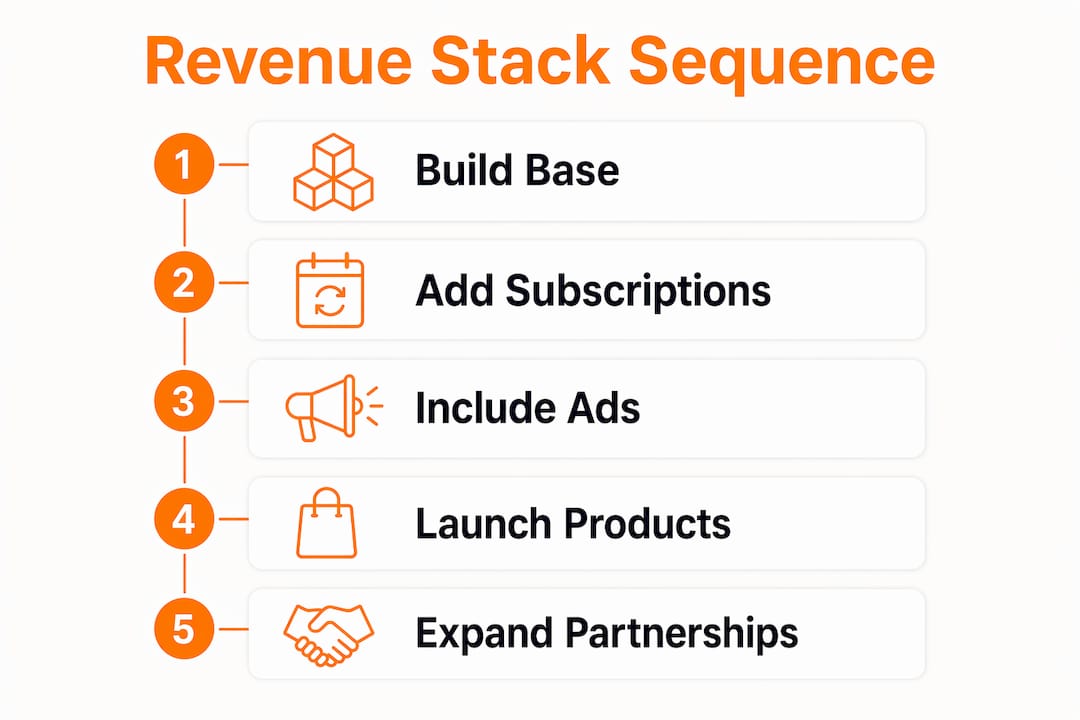
Effective monetization sequencing starts with one anchor offer that stabilizes cash flow before adding streams that scale with low incremental cost. Trying to run sponsorships, a course, an affiliate program, and a membership simultaneously before any of them are mature is the fastest way to build nothing well.
The recommended sequence for building a creator business framework:
- Launch a paid community or membership. This is your anchor. Even at $10 per month with 100 members, you have $1,000 in predictable monthly revenue to build from.
- Add digital products. Once your community tells you what they need, build it. Courses, templates, and guides sell naturally to an engaged paid audience.
- Layer in affiliate deals. Recommend tools your community already uses. The trust is already there.
- Introduce sponsorships selectively. Only after your owned revenue is stable. Sponsorships should add to your income, not define it.
- Explore paid DMs or coaching. High-value, time-limited offers for your most committed members.
Platform fees directly impact creator take-home revenue and influence which platform you choose for subscriptions. At $10,000 per month in membership revenue, the difference between a 5% and 12% platform fee is $700 per month. That is $8,400 per year lost to platform choice alone.
| Platform | Fee structure | Net on $10K/month |
|---|---|---|
| Patreon | 8–12% | $8,800–$9,200 |
| Substack | 10% | $9,000 |
| OnlyFans | 20% | $8,000 |
| Stripe direct | 2.9% + $0.30/transaction | ~$9,700 |
Pro Tip: Running your membership through Stripe directly, rather than through a third-party platform, can recover thousands of dollars annually in platform fees once your community exceeds a few hundred members.
What operational strategies drive retention and consistent income?
Launching a paid community is the beginning, not the finish line. Retention engineering requires designing a member journey that includes onboarding, proof of value, and ongoing programming to reduce churn and build habitual engagement. Most creators underinvest here and then wonder why members cancel after 60 days.
The operational pillars of a sustainable creator business:
- Onboarding sequences: New members need to experience value within the first 48 hours. A welcome email, a quick-start guide, and a community introduction post are the minimum.
- Repeatable content pipelines: Weekly live sessions, monthly challenges, or recurring content drops give members a reason to stay. Consistency signals professionalism.
- Community programming: Structured events, Q&A sessions, and member spotlights create belonging. Belonging reduces churn more reliably than content volume.
- Proof of value moments: Regular wins, case studies, and member results remind subscribers why they pay. Document and share these actively.
- Payment recovery automation: Automated payment recovery reduces involuntary subscriber churn by 20 to 40%. Failed payments account for a significant share of membership losses, and most creators never address this.
Retention is driven more by engagement and community experience than by follower count. A creator with 2,000 highly engaged community members will outperform one with 200,000 passive followers every time. The metric that matters is not reach. It is relationship depth.
Technology plays a direct role here. Tools that handle customer retention automation can manage onboarding sequences, payment retries, and engagement triggers without requiring manual effort from the creator. This is how solo creators operate like businesses without hiring a team.
Pro Tip: Set up a dunning sequence the day you launch your membership. Recovering even 30% of failed payments can add hundreds of dollars monthly to your net revenue with zero additional content creation.
Key takeaways
A sustainable creator business model requires recurring revenue as its anchor, owned audience assets as its foundation, and retention systems as its engine.
| Point | Details |
|---|---|
| Recurring revenue first | Launch a paid community or membership before adding other revenue streams. |
| Own your audience | Build email lists and paid communities to reduce dependency on platform algorithms. |
| Sequence your revenue stack | Add digital products, affiliates, and sponsorships only after your anchor offer is stable. |
| Platform fees matter | Choosing Stripe over Patreon or OnlyFans can recover thousands annually at scale. |
| Retention drives income | Onboarding, community programming, and payment recovery determine long-term revenue more than audience size. |
Why most creators build content, not businesses
I have watched creators with audiences of 500,000 followers earn less per month than creators with 800 paid community members. The difference is never talent or content quality. It is structure. Most creators build content pipelines and call it a business. They optimize for views, follower growth, and engagement metrics that do not convert to income without a deliberate monetization architecture underneath them.
The mistake I see most often is chasing multiple one-off revenue models before any single stream is stable. A creator launches a course, a sponsorship deal, and a Patreon in the same month, then burns out managing all three while none of them generates meaningful income. Starting small with one recurring offer, even at a modest price point, creates the cash flow stability that makes everything else possible.
Engagement matters more than reach, and I mean that in a specific way. A creator with strong audience relationships and 5,000 email subscribers can generate more revenue than one with 500,000 platform followers and no owned channel. The follower count is borrowed. The email list is yours. Build the thing you own.
The creators who thrive long-term treat audience ownership as a non-negotiable operating principle, not a nice-to-have. They use platforms for discovery and their own channels for monetization. They build recurring revenue before they build anything else. And they invest in retention systems before they invest in growth. That sequence is not intuitive, but it is the one that works.
— Sale
Build your creator business with Revenueoperator
If you are ready to move from inconsistent content income to a structured, predictable revenue system, Revenueoperator is built for exactly that.
Revenueoperator’s Monetization Architecture Method gives digital creators a proven framework for transitioning audiences from free engagement to paid offerings without trial and error. The system covers recurring revenue setup, audience ownership strategy, and retention infrastructure. Creators who have implemented this method report moving from unpredictable monthly earnings to stable, growing income. Visit revenueoperator.io to see how the architecture works and whether it fits your current stage of creator business growth.
FAQ
What is a creator business model?
A creator business model is a structured system for converting a content audience into predictable revenue through subscriptions, digital products, affiliate deals, and sponsorships. It differs from ad-based content creation by prioritizing recurring income and direct audience relationships over platform-dependent earnings.
How do creators make money beyond ads?
Creators generate income through paid communities, digital products, affiliate commissions, sponsorships, and coaching. Paid communities alone can generate 10 to 100 times more revenue per 1,000 fans than ad-based models, making them the most efficient monetization method for most creators.
Why does audience ownership matter for creator income?
Owned audiences, including email lists and paid community members, are not subject to platform algorithm changes or policy shifts. Platform reach can disappear overnight, but an email list or paid membership stays with the creator regardless of what any platform decides.
What is the best first step for monetizing a creator business?
Start with one recurring offer, typically a paid community or membership, before adding other revenue streams. Starting with an anchor offer stabilizes cash flow and gives you a paying audience to upsell before you invest time in courses, sponsorships, or affiliate programs.
How do you reduce churn in a paid creator community?
Reduce churn through structured onboarding, consistent content programming, and automated payment recovery. Automated payment recovery alone reduces involuntary churn by 20 to 40%, and most creators never implement it despite it being one of the highest-return operational improvements available.