Influencer Audience Monetization Mistakes to Fix Now

Influencer audience monetization mistakes are the single most predictable reason content creators plateau at inconsistent income despite growing audiences. Most creators spend years building loyal followings, then undermine that work by relying on platform ad revenue, skipping attribution on gifting campaigns, or launching products before their audience trusts them enough to buy. The gap between a creator earning $2,000 a month and one earning $20,000 is rarely about content quality. It is almost always about revenue architecture. This article breaks down the most costly errors, with specific numbers and fixes, so you can stop leaving money on the table.
1. Relying solely on platform ad revenue
Platform ad revenue is the most common influencer income pitfall, and the math explains why. Creators earning the standard $3 to $8 per 1,000 views on YouTube or TikTok generate roughly $1,500 to $4,000 monthly at 500,000 views. That same audience, offered a direct digital product at a 2 to 3% purchase rate, can generate $30,000 to $100,000 monthly. The difference is not effort. It is structure.
Creators who never build direct offers are effectively renting their income from platforms that can change payout rates without notice. YouTube has adjusted its Partner Program thresholds multiple times. TikTok’s creator fund has paid fractions of what early participants expected. Every algorithm update is a pay cut you did not negotiate.

The fix is not to abandon platform content. It is to treat platform content as a top-of-funnel tool that drives audiences toward owned offers: courses, memberships, digital downloads, or coaching programs. A creator with 50,000 engaged subscribers and a $97 course converts more revenue than one with 500,000 passive viewers living entirely on ad checks.
Pro Tip: Build your first direct offer before you think you are ready. The habit of creating free content while waiting for the “right moment” to monetize is itself a monetization error.
2. Skipping attribution in gifting campaigns
Gifting campaigns without attribution are not marketing. They are charity with a logo on it. Impact highlights that the most common gifting misstep is treating product sends as awareness plays with no conversion tracking, which makes it impossible to measure ROI or improve the program over time.
The pre-launch checklist for any gifting campaign must include three things: affiliate links tied to each creator, unique promo codes per creator, and UTM parameters on every URL. Without these, you cannot separate which creator drove purchases from which drove nothing. You cannot optimize. You cannot scale.
Poor creator selection compounds the problem. Sending product to creators whose audience demographics do not match your buyer profile wastes both product and potential. A skincare brand gifting to a gaming creator with a 90% male teen audience is not a reach play. It is a mismatch that produces zero data and zero sales.
“Treat gifting like performance marketing by establishing attribution from the start; otherwise, conversion data are missing and optimization is impossible.” — Impact
The smartest gifting programs evolve compensation models as creator relationships mature. Start with product only, move to a hybrid of product plus commission, then graduate top performers to paid partnership status. This progression rewards results and builds creator loyalty without inflating upfront costs.
3. Running influencer marketing as one-off campaigns
One-off influencer campaigns produce one-off results. Kalyan Kumar warns that influencers have a measurable shelf life, and brands or creators who treat each campaign as isolated lose the compounding effect that makes influencer marketing genuinely powerful. Audience churn accelerates when content feels transactional rather than relational.
The metric most creators and brands ignore is branded search movement. When an influencer campaign works, people search for the brand or product by name. That branded search lift is a direct signal of purchase intent and long-term revenue potential. Reach and impressions tell you who saw something. Branded search tells you who cared enough to act.
Pro Tip: Set up Google Search Console or a branded keyword tracker before launching any campaign. Measure branded search volume before and after. That delta is your real performance indicator.
Structured, always-on creator programs outperform campaign bursts because they build audience familiarity over time. A creator who mentions a product once is an ad. A creator who uses a product consistently across six months of content is a trusted recommendation. The revenue difference between those two scenarios is not marginal. It is categorical.
- Always-on programs reduce creator onboarding costs by reusing existing relationships
- Consistent creator content trains algorithms to surface brand-adjacent content more frequently
- Long-term creator partnerships produce higher-quality content as creators internalize the brand voice
- Branded e-commerce search movement is the North Star KPI for measuring real campaign impact
4. Mishandling FTC disclosure requirements
FTC compliance is not optional, and the penalties for getting it wrong are not symbolic. As of 2026, violations can reach $51,744 per incident, which means a single undisclosed sponsored post can cost more than most creators earn in a quarter. That number should end any debate about whether disclosure is worth the friction.
The most common compliance mistake is assuming that a platform’s built-in “Paid Partnership” label satisfies FTC requirements. It does not. The FTC requires that disclosures be clear and conspicuous, meaning #ad or #sponsored must appear in the first three lines of a caption, not buried after “read more.” Video content requires verbal disclosure in the script, not just a text overlay that disappears in three seconds.
| Disclosure method | FTC compliant? | Notes |
|---|---|---|
| Platform “Paid Partnership” label only | No | Insufficient without additional hashtag or verbal disclosure |
| #ad in first caption line | Yes | Must appear before any “read more” truncation |
| Verbal mention in video script | Yes | Required for video content alongside caption disclosure |
| #ad buried after 10 hashtags | No | Not clear and conspicuous per FTC standard |
| AI-generated content, undisclosed | No | Must be disclosed equivalently to human-created sponsored content |
Embedding disclosure requirements directly into creator briefs and contract templates removes the compliance burden from individual judgment calls. When the brief specifies exact hashtag placement and required verbal language, compliance becomes a workflow step rather than an afterthought.
Pro Tip: Add a disclosure checklist to your content approval process. Before any sponsored post goes live, verify: hashtag in first three caption lines, verbal mention in video, and platform label activated. Three checks, zero violations.
5. Depending on a single platform for all audience access
Platform dependency is the structural vulnerability that makes every other monetization error worse. Creators with no owned channels face compounding risk: algorithm changes reduce reach, monetization policy shifts cut revenue, and account suspensions can eliminate years of audience building overnight. The platform owns the relationship. You are a tenant.
The owned audience alternative is an email list. Email delivers an average open rate that no social algorithm can suppress. A creator with 10,000 email subscribers has a direct line to buyers that no platform update can interrupt. Substack, ConvertKit, and Beehiiv all offer tools to build and monetize that list independently of any social platform.
- Build an email capture mechanism into every piece of content: lead magnets, free downloads, and newsletter sign-up links in bio
- Use platform content to drive traffic to owned channels, not just to accumulate followers
- Diversify across at least two platforms to reduce single-point-of-failure risk
- Treat your email list as your primary asset and social followings as distribution channels
Premature monetization compounds platform dependency risk. Creators who push paid offers before establishing trust and content habits train their audiences to disengage. Once that disengagement pattern sets in, it caps future revenue potential regardless of how good the offer is. Sequence matters: build trust, build habit, then introduce commercial offers.
6. Launching offers without audience trust or habit formation
Monetization must follow audience habit building. Creators who add offers to audiences that have not yet formed a consistent content consumption habit are not monetizing. They are extracting, and audiences feel the difference immediately. The result is low conversion rates, high refund rates, and a damaged relationship that takes months to repair.
The signal that an audience is ready to buy is behavioral, not numerical. An audience of 5,000 people who open every email, comment on every post, and share content regularly is more monetizable than 100,000 passive followers who scroll past without engaging. Engagement rate, reply rate, and direct message volume are the real readiness indicators.
Successful monetization sequences look like this: free value for 60 to 90 days, then a low-cost entry offer, then a premium product to buyers who proved they would pay. Skipping the entry offer and going straight to a $500 course is a common misstep in audience monetization that burns trust and produces disappointing launch numbers. The ladder matters as much as the product.
Key takeaways
Influencer revenue errors follow predictable patterns, and fixing them requires structural changes to how you build, engage, and monetize your audience.
| Point | Details |
|---|---|
| Platform ad revenue ceiling | Creators on ad-only models cap out far below what direct product offers can generate at the same audience size. |
| Attribution is non-negotiable | Every gifting campaign needs affiliate links, promo codes, and UTM parameters before the first product ships. |
| Compliance protects income | FTC violations cost up to $51,744 per incident; disclosure must be explicit in captions and video scripts. |
| Own your audience | Email lists and owned channels are the only monetization assets that platform algorithm changes cannot touch. |
| Sequence before selling | Build audience trust and content habits before introducing paid offers to avoid disengagement and revenue caps. |
Why most monetization advice gets the sequence wrong
Most monetization content tells you what to sell. Very little tells you when to sell it, and that sequencing gap is where most influencer income pitfalls actually originate. I have watched creators with genuinely strong audiences launch products that flopped not because the product was bad, but because the audience had not yet formed the habit of showing up consistently. The launch felt like an interruption rather than a natural next step.
The creators I have seen build the most consistent revenue share one discipline: they treat audience trust as a prerequisite, not a nice-to-have. They spend real time, often 60 to 90 days minimum, delivering free value with no commercial ask before introducing any offer. When the offer finally arrives, it converts because the audience already believes in the creator’s judgment.
Vanity metrics are the other trap. Reach numbers and follower counts feel like progress, but they tell you nothing about purchase intent. Branded search volume, email open rates, and direct message frequency are the signals that actually predict revenue. Creators who optimize for those numbers build income. Creators who optimize for follower counts build audiences that sponsors rent and then leave.
Compliance is the unglamorous part that separates professional creators from hobbyists. Embedding FTC disclosure language into every brief, every contract, and every content checklist is not bureaucratic overhead. It is the operational discipline that keeps a six-figure creator business from becoming a five-figure legal problem. Build the systems before you need them.
— Sale
Build a revenue system that actually works
If any of these mistakes sound familiar, the issue is not your content or your audience size. It is the absence of a structured monetization architecture behind your creative work.
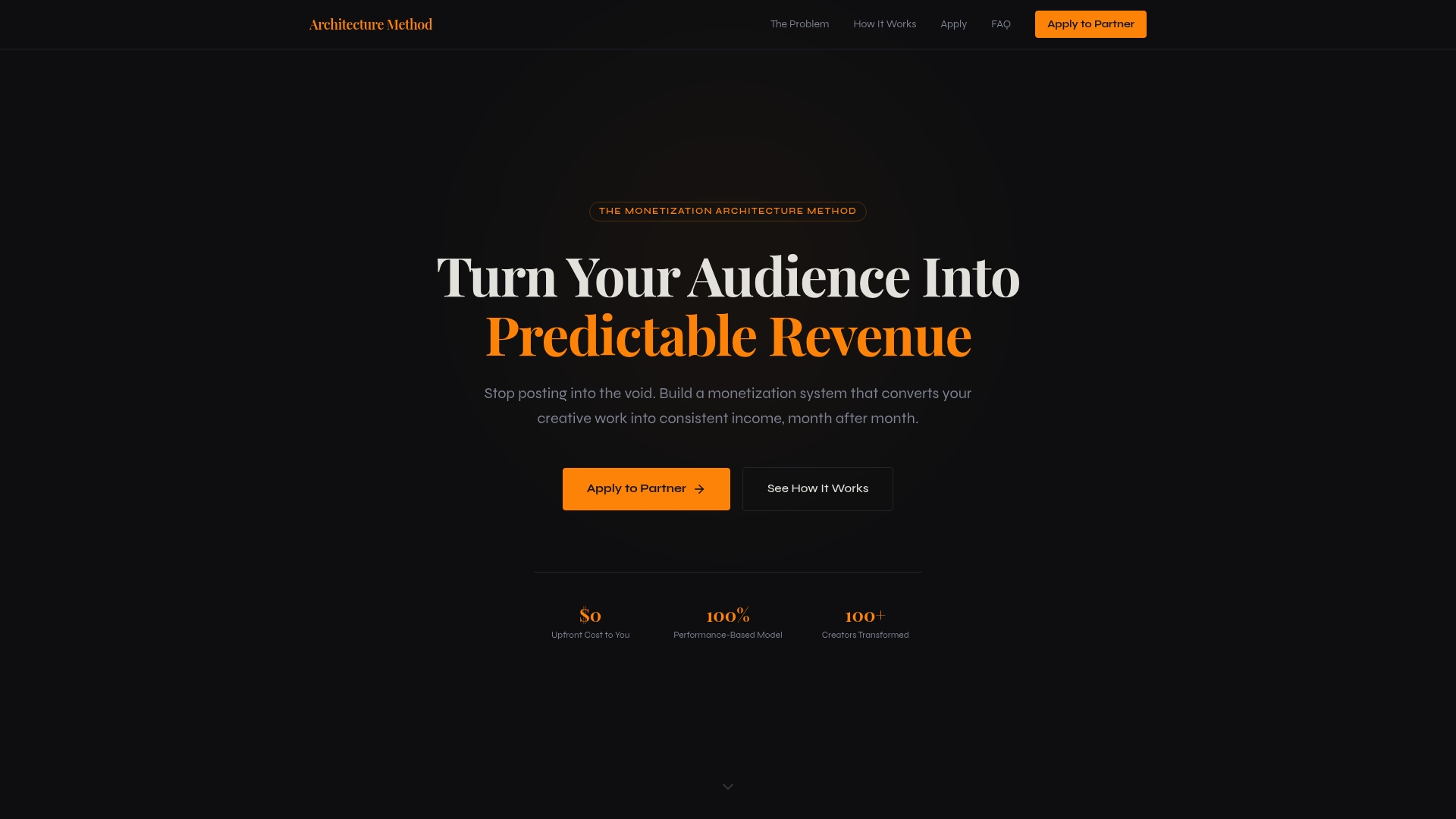
Revenueoperator’s Monetization Architecture Method is built specifically for creators who are tired of inconsistent income and want a repeatable system that moves audiences from free engagement to paid offers without guessing. Creators using this framework have shifted from unpredictable monthly earnings to reliable, structured revenue by following a proven sequence of trust-building, offer design, and audience conversion. If you are ready to stop treating monetization as an afterthought, start here and see how the architecture applies to your specific audience and offer mix.
FAQ
What are the biggest influencer audience monetization mistakes?
The most costly mistakes are relying solely on platform ad revenue, skipping attribution in gifting campaigns, and launching paid offers before building audience trust. Each of these errors limits revenue potential and creates income instability that compounds over time.
How much can creators lose by depending only on ad revenue?
Creators earning $3 to $8 per 1,000 views generate $1,500 to $4,000 monthly at 500,000 views. The same audience offered a direct product at a 2 to 3% purchase rate can produce $30,000 to $100,000 monthly, representing losses that exceed $50,000 annually for ad-only creators.
What FTC disclosure rules apply to influencers in 2026?
The FTC requires that #ad or #sponsored appear in the first three lines of any caption and that video content includes a verbal disclosure in the script. Platform paid partnership labels alone do not satisfy these requirements, and violations can reach $51,744 per incident.
Why is an email list more valuable than social followers for monetization?
Email lists are owned assets that no algorithm can suppress or remove. Social platform reach is controlled by third-party systems that change without notice, while an email list gives creators direct access to their audience regardless of platform policy changes.
When should an influencer start monetizing their audience?
Monetization works best after an audience has formed consistent content consumption habits, typically after 60 to 90 days of free value delivery. Launching paid offers before that habit forms signals extraction to the audience and produces low conversion rates and high disengagement.