Knowledge Product Monetization Framework for Creators

A knowledge product monetization framework is a structured system that converts your expertise into predictable, scalable revenue by combining targeted pricing, deliberate packaging, and repeatable delivery methods. Most creators skip the framework entirely and wonder why their income fluctuates month to month. The answer is almost always structural, not motivational. Tools like Stripe for payment processing, Teachable for course delivery, and Alysium AgentHub for AI-powered knowledge products each play a defined role inside a working framework. Without the architecture connecting them, you are just selling one-off products and hoping for the best.
What is a knowledge product monetization framework?
A knowledge product monetization framework is the operating system underneath your digital product business. It defines how you price, package, deliver, and scale your expertise so that revenue compounds rather than resets every month. The framework concept is not new. Publishers have used licensing architectures for decades, and enterprise data teams follow formal monetization models before releasing any product to market. What is new is that individual creators now have access to the same structural thinking through platforms and methods previously reserved for large organizations.
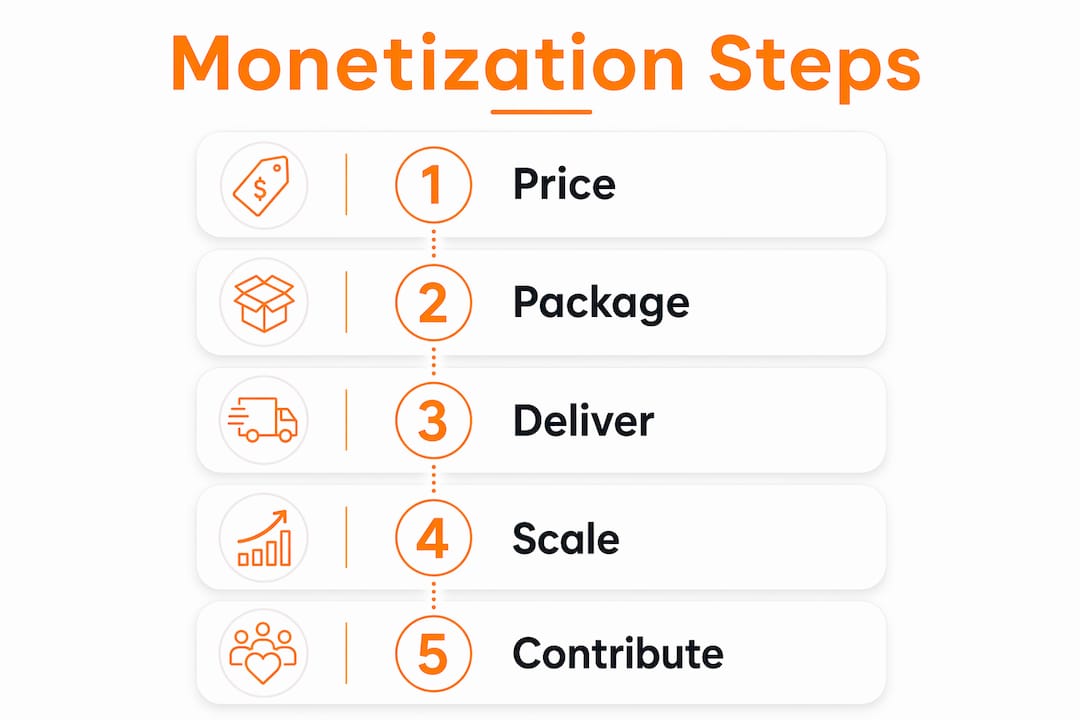
The framework has four core components: pricing anchored to buyer value, packaging that organizes knowledge for precision and usability, a delivery mechanism that matches the buyer’s context, and a scaling layer that multiplies revenue without multiplying your hours. Each component depends on the others. Strong packaging with weak pricing leaves money on the table. Great pricing with poor delivery creates refund requests. Revenueoperator’s Monetization Architecture Method is built around exactly this four-part structure, and it is the reason creators using it move from inconsistent earnings to predictable monthly income.

How to price knowledge products based on buyer value
Pricing is the single highest-leverage decision in any digital product revenue model, and most creators get it wrong by anchoring to cost instead of value. The time you spent creating a course is irrelevant to what a buyer will pay. What matters is the outcome your product delivers and how much that outcome is worth to the buyer.
Pricing anchored to buyer value consistently outperforms cost-plus models because buyers evaluate purchases against the result they expect, not the effort behind the product. A $47 course and a $497 course can solve the same problem, but the $497 version signals higher confidence and attracts buyers who are more committed to implementation. That commitment directly improves your completion rates, testimonials, and referrals.
The most effective approach uses three price tiers:
- Entry tier ($27 to $97): A focused, low-risk product that converts cold audiences. Think a single-topic ebook, a workshop recording, or a template pack.
- Core tier ($197 to $997): Your primary offer. A structured course, a coaching program, or an AI knowledge agent built on your methodology.
- Premium tier ($1,500 and above): High-touch delivery. Done-with-you programs, licensing arrangements, or enterprise access to your knowledge base.
Multi-tier pricing captures buyers at different willingness-to-pay levels and increases total revenue even when the higher-priced tier sells at lower volume. The math consistently favors higher prices with somewhat lower volume over lower prices chasing maximum unit sales.
Pro Tip: Use an income projection simulator before finalizing your price points. Plug in three scenarios: conservative, moderate, and optimistic conversion rates at each tier. The output almost always reveals that a 20% price increase costs you far fewer sales than you fear.
Pricing discipline is systemic, not intuition-based. Creators who test prices quarterly and track revenue per buyer, not just total sales, consistently outperform those who set a price once and leave it.
How should you package and structure knowledge products?
Packaging determines whether your knowledge is actually usable or just technically available. A 200-page PDF covering everything you know is not a product. It is a liability. Buyers who feel overwhelmed do not ask for help. They ask for refunds.
Packaging knowledge as 3 to 5 focused documents rather than one comprehensive file improves retrieval precision and buyer satisfaction, particularly for AI-powered knowledge products. The same principle applies to courses, ebooks, and coaching programs. Focused modules outperform sprawling curricula every time.
Effective packaging uses three content layers, each serving a different buyer need:
| Content layer | What it contains | Why it matters |
|---|---|---|
| Conceptual | Core principles, frameworks, mental models | Gives buyers the “why” behind your method |
| Procedural | Step-by-step instructions, checklists, workflows | Delivers the “how” buyers can act on immediately |
| Contextual | Case studies, examples, edge cases, FAQs | Builds confidence and handles objections |
These three layers make AI agents more effective and buyers more satisfied because they mirror how people actually learn: understanding a concept, applying a process, and seeing it work in a real situation. Skipping the contextual layer is the most common packaging mistake. Buyers who cannot see themselves in your examples disengage before they get results.
For AI knowledge products specifically, uploading documents in a prioritized order matters. Start with your core framework documents, then supporting materials, then edge cases. This sequence trains the agent to prioritize your primary methodology before handling exceptions.
Platforms like Alysium AgentHub handle AI product distribution, while Teachable and Kajabi cover course delivery. The platform choice should follow your product format, not the other way around.
Why customer contributions can compound your product’s value
The contributor flywheel model is one of the most underused strategies in knowledge product monetization. The concept is straightforward: buyers and practitioners who use your product contribute validated knowledge back into it, improving accuracy and depth over time. You get a better product. They get a stronger tool. Both sides win.
The corpus contributor model works because it creates a bilateral knowledge relationship. Your buyers are often domain practitioners with real-world experience your original product did not capture. When you build a structured pathway for them to contribute, you are tapping into a distributed research network that no solo creator can replicate internally.
The mechanism that makes this defensible is the validation layer. Every contribution passes through a review queue before entering the product. This is not crowdsourcing. Crowdsourcing accepts volume. The contributor model accepts quality.
“A domain-aware validation layer that surfaces conflicts and resolves them transparently is what separates a contributor model from a wiki. It is the difference between a moat and a mess.”
Incentives for contributors do not need to be expensive. Effective options include:
- Discounts on future products or renewals
- Early access to updated versions
- Public credit in the product or community
- Access to a contributor-only tier with premium content
Contributor participation transforms customers into co-creators, which strengthens retention and makes your product genuinely harder to replicate. A competitor can copy your curriculum. They cannot copy two years of validated practitioner contributions.
What prerequisites do you need before scaling monetization?
Scaling a knowledge product business without operational readiness is how creators end up with five products that each generate inconsistent revenue instead of one product that generates predictable income. The prerequisites are not glamorous, but skipping them is expensive.
Successful monetization requires a defined model, high-impact use cases, data quality, security considerations, and organizational alignment before scaling efforts begin. For individual creators, this translates into a practical preflight checklist:
- Define your monetization model. Are you selling one-time access, subscriptions, licensing, or a combination? Each model has different cash flow patterns and buyer expectations. Decide before you build.
- Audit your knowledge quality. Outdated, contradictory, or incomplete content inside a paid product destroys trust faster than any marketing mistake. Review your core materials before packaging them.
- Map your use cases. Who specifically benefits from your product, and what specific outcome do they achieve? Vague use cases produce vague marketing and weak conversion rates.
- Plan for compliance basics. If your product includes financial, legal, medical, or regulated content, add appropriate disclaimers and review your platform’s terms of service.
- Align your operations. If you have a team, a VA, or contractors, clarify who handles customer support, updates, and contributor review before you launch.
Pro Tip: Write a one-page product brief before building anything. Include the buyer persona, the core outcome, the price tier, and the delivery format. Creators who skip this step routinely rebuild products after launch because the original scope drifted.
Operational readiness including data governance and internal alignment is consistently the most overlooked factor in monetization success. It is also the factor most directly within your control.
How to scale your knowledge product portfolio
Scaling is not about creating more products faster. It is about building a product ladder that serves buyers at every stage of their journey with you. A buyer who starts with your $47 template pack and eventually purchases your $2,000 coaching program is worth dramatically more than a buyer who only ever sees one offer.
The most effective portfolio structures share a common architecture:
- Awareness products: Free or low-cost items that demonstrate your methodology. Lead magnets, free workshops, and $27 entry products belong here.
- Core products: Your primary paid offer. This is where most of your revenue should concentrate.
- Expansion products: Add-ons, advanced modules, or community access that increase the value of the core purchase.
- High-ticket products: Done-with-you programs, licensing deals, or enterprise contracts. Publishers using platforms like Snowflake’s Cortex Knowledge Extensions have secured six-figure licensing deals by packaging trusted content for AI access. The same licensing logic applies at a smaller scale for individual creators.
Distribution should combine direct audience marketing with marketplace discovery. Your email list converts at higher rates than any marketplace. Marketplaces like Gumroad, Alysium AgentHub, or Udemy provide discovery for buyers who do not yet know you exist. Both channels serve different acquisition functions and should run simultaneously.
IP ownership is a non-negotiable consideration when choosing platforms. Some platforms claim licensing rights to content hosted on their infrastructure. Read the terms before you build your core product on any third-party system.
Key takeaways
A knowledge product monetization framework succeeds when pricing reflects buyer value, packaging organizes knowledge into focused layers, and operations are ready before scaling begins.
| Point | Details |
|---|---|
| Price to buyer value | Use three tiers and test quarterly; higher prices with lower volume often generate more total revenue. |
| Package in focused layers | Use 3 to 5 documents with conceptual, procedural, and contextual content rather than one large file. |
| Build a contributor model | Validated customer contributions compound product quality and create a competitive moat over time. |
| Complete the preflight checklist | Define your model, audit knowledge quality, and map use cases before scaling any product. |
| Build a product ladder | Structure offerings from awareness to high-ticket so buyers have a clear path to deeper engagement. |
Why most creators skip the hardest part of this framework
I have reviewed dozens of creator monetization setups, and the pattern is almost always the same. The product is good. The pricing is guesswork. The packaging is a single large document or a course with 47 modules that nobody finishes. And the operational side, the model definition, the use case mapping, the contributor pathway, has never been touched.
The contributor model is the piece I find most undervalued. Creators treat their buyers as an audience to sell to rather than a knowledge network to build with. The creators who build durable businesses are the ones who figure out that their best buyers are also their best product developers. You do not need a research team. You need a validation process and the willingness to credit the people who improve your work.
Pricing discipline is the second area where I see the most money left behind. Gut-feel pricing almost always undershoots. When you run the numbers through even a basic projection model, the case for raising prices is usually obvious. The fear is psychological, not mathematical.
The framework is not complicated. It is disciplined. The creators who apply it consistently, even imperfectly, outperform those who keep optimizing their content without ever fixing the structure underneath it.
— Sale
Build predictable revenue with Revenueoperator
If you have been building knowledge products without a clear monetization structure, the gap between your current income and your potential income is almost entirely architectural.

Revenueoperator’s Monetization Architecture Method gives digital creators and course developers a proven system to move audiences from free content to paid products without guessing. The method covers pricing model design, product packaging, and the operational setup that makes revenue predictable rather than reactive. Creators who have applied it report moving from inconsistent monthly earnings to stable, compounding income. If you are ready to stop rebuilding your offers from scratch every quarter, explore the full creator monetization system at Revenueoperator and see exactly how the architecture works.
FAQ
What is a knowledge product monetization framework?
A knowledge product monetization framework is a structured system that organizes how you price, package, deliver, and scale expertise-based products to generate predictable revenue. It connects tools like Stripe, Teachable, and Alysium AgentHub into a repeatable revenue architecture.
How do you price a knowledge product effectively?
Price to buyer value, not build cost. Use three tiers covering entry, core, and premium offers, and test pricing quarterly using income projection simulators to capture different willingness-to-pay levels.
What is the best format for packaging knowledge products?
Package knowledge as 3 to 5 focused documents or modules rather than one large file. Include conceptual, procedural, and contextual layers to serve different learning needs and improve buyer satisfaction.
What is the corpus contributor model?
The corpus contributor model is a system where buyers contribute validated knowledge back into your product, improving its accuracy and depth over time. A domain-aware validation layer reviews all contributions before they enter the product, maintaining quality and reliability.
What do you need before scaling a knowledge product business?
Before scaling, define your monetization model, audit your content quality, map specific buyer use cases, and align your operations. These prerequisites prevent the inconsistent revenue that results from scaling a structurally weak product.