Newsletter Monetization Business: Your 2026 Revenue Guide

Newsletter monetization is defined as the practice of converting an email subscriber list into a commercial media asset that generates revenue through layered income streams including sponsorships, paid subscriptions, and owned products or services. The role of newsletter monetization in a creator’s business has shifted from optional side income to a primary revenue architecture. Platforms like Substack and Beehiiv have normalized this shift, giving creators direct access to tools that were once reserved for media companies. Email remains the only distribution channel you fully own, and that ownership is the foundation of every monetization strategy worth building.
What are the main newsletter monetization models and how do they compare?
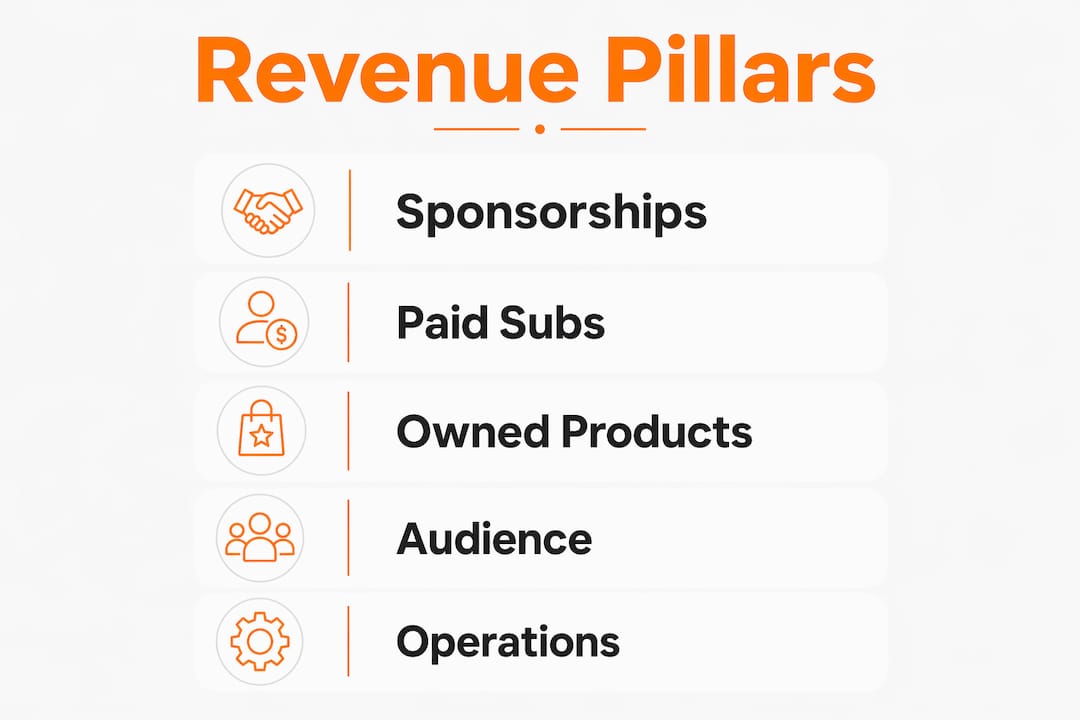
Newsletter monetization transforms an email list into a commercial media asset using three primary revenue pillars: sponsorships, paid subscriptions, and owned products or services. Successful creators combine all three rather than relying on a single stream. Each model has a different scale threshold, margin profile, and content requirement.
Sponsorships and advertising
Sponsorships are the most visible newsletter revenue strategy, but they require meaningful scale before they pay well. Sponsorship CPMs in finance range from $20 to $100 or more depending on list size and open rates. A finance newsletter with 10,000 subscribers and a 40% open rate can charge $80 to $400 per primary placement. That range illustrates why engagement matters more than raw subscriber count when pitching sponsors.

Paid subscriptions
Paid subscriptions offer predictable monthly income, but conversion rates are modest. Subscription conversion rates typically fall between 1% and 5%, meaning a 500-subscriber list generates 5 to 25 paying members at $10 per month. That translates to $50 to $250 monthly before fees. The math improves dramatically at scale, which is why subscriptions reward creators who invest in list growth alongside content quality.
Owned products and services
Consulting, digital courses, and paid communities carry the highest margins of any newsletter business model. Consulting and done-for-you services can generate $2,000 to $10,000 per month with a small but engaged audience. The newsletter functions as a live portfolio, demonstrating expertise before a prospect ever books a call. This model gives creators the most control and the least dependence on platform rules or advertiser budgets.
| Revenue model | Scale required | Margin | Control |
|---|---|---|---|
| Sponsorships | High (10,000+ subscribers) | Medium | Low |
| Paid subscriptions | Medium (1,000+ subscribers) | Medium | Medium |
| Owned products/services | Low (100+ engaged readers) | High | High |
| Affiliate marketing | Medium | Low to medium | Low |
Pro Tip: Start with consulting or a digital product before chasing sponsorships. You can generate meaningful revenue at 300 subscribers if your audience is engaged and your offer solves a specific problem.
How does audience engagement impact newsletter monetization success?
Engagement is the actual currency of newsletter monetization, not subscriber count. Open rates above 40% and click-through rates two to three times the industry average correlate directly with higher sponsorship rates and stronger subscription conversion. A list of 2,000 highly engaged readers outperforms a list of 20,000 passive ones in nearly every revenue scenario.
Here is how to build and protect engagement as a monetization asset:
- Publish on a consistent schedule. Irregular cadence trains readers to ignore your emails. Weekly or biweekly publishing builds the habit of opening before you ever ask for money.
- Segment your content by reader behavior. Readers who click on specific topics are signaling what they value. Use that data to deepen content in those areas and pitch relevant sponsors or products.
- Clean your list regularly. Inactive subscribers suppress open rates and can disqualify you from platform monetization programs. Remove subscribers who have not opened in 90 days.
- Gate your best content strategically. Offering a free taste of premium content converts curious readers into paying subscribers faster than a cold pitch.
- Track click-through rate alongside open rate. Open rate measures curiosity. Click-through rate measures trust. Both matter, but CTR is the stronger signal for monetization readiness.
Beehiiv’s Ad Network 2.0 makes this concrete. Beehiiv’s programmatic sponsorships are gated by a minimum average open rate of approximately 30%, with CPMs ranging from $45 to $120. That threshold exists because advertisers pay for attention, not addresses. If your open rate falls below the minimum, you lose access to the network entirely. List hygiene and consistent audience care are not optional extras. They are eligibility requirements.
Pro Tip: Prepare an advertiser media kit before you pitch your first sponsor. Include your open rate, click-through rate, subscriber demographics, and two or three reader testimonials. Sponsors require transparent performance evidence beyond raw subscriber counts, and a polished kit closes deals faster.
What operational and platform economics should you know to maximize newsletter revenue?
Platform fees reduce your gross revenue before you spend a dollar on growth. Understanding the math protects your margins and informs which monetization model to prioritize at each stage.
- Substack fees: Substack charges 10% of gross subscription revenue plus Stripe transaction fees of approximately 2.9% plus $0.30 per transaction. On a $10 monthly subscription, creators keep roughly $8.36 to $8.70 after all deductions. At scale, that 13 to 16% total fee becomes a significant line item in your P&L.
- Non-exclusive sponsorship partnerships: Working with platforms like Media Intercept or Beehiiv’s ad network preserves your editorial freedom while filling inventory you cannot sell directly. Non-exclusive arrangements mean you can still pursue direct deals at higher CPMs.
- Audience trust before paid tiers: Launching paid subscriptions prematurely to a cold or disengaged list produces poor conversion and high churn. Consistent free publishing for at least three to six months builds the trust that makes a paid tier viable.
- P&L mindset: Treating your newsletter as a business with financial tracking and commercial planning dramatically improves monetization outcomes compared to treating it as a content hobby. Track revenue by stream, cost per subscriber acquired, and net margin monthly.
- Reporting infrastructure: Sponsors require transparent performance data. Build a reporting template that includes open rate, CTR, subscriber growth, and audience demographics before you approach your first advertiser.
The operational discipline that separates profitable newsletter businesses from struggling ones is not creative output. It is financial clarity. Creators who know their revenue per subscriber, their cost per acquisition, and their net margin by channel make better decisions about where to invest time and money.
How do you integrate multiple monetization streams for sustained growth?
Layering revenue streams is the defining characteristic of a durable newsletter business. Single-stream creators are one algorithm change, one sponsor pullout, or one platform policy shift away from a revenue crisis. The integration strategy below is sequenced by audience size and engagement, not by ambition.
- Start with services. If your list is under 1,000 subscribers, consulting or coaching is your fastest path to meaningful revenue. The newsletter demonstrates expertise. The service converts that expertise into income. Use this phase to fund content production and list growth.
- Introduce digital products at 1,000 to 5,000 subscribers. A focused guide, template pack, or mini-course priced at $27 to $97 converts well to an engaged list and requires no ongoing delivery time. Aligning your product to your monetization model improves both audience fit and conversion rates.
- Launch a paid subscription tier at 2,000 to 5,000 subscribers. By this point, your free audience has demonstrated consistent engagement. A paid tier priced at $7 to $15 per month adds recurring revenue and functions as a trust accelerator, making it easier to sell higher-ticket offers to subscribers who have already paid you something.
- Add sponsorships at 5,000 or more subscribers. Direct sponsorship deals become viable at this scale, especially in high-value niches. Use Beehiiv’s ad network or Media Intercept to fill remaining inventory programmatically.
- Build a paid community or cohort program at 10,000 or more subscribers. This is the highest-leverage offer in the newsletter business model stack. A community priced at $50 to $200 per month generates substantial recurring revenue and deepens audience relationships simultaneously.
Track your revenue per subscriber across all streams monthly. If one channel’s contribution drops, investigate before it becomes a structural problem. Using the newsletter as a top-of-funnel layer that funnels trust into downstream owned offers produces more sustainable monetization than relying heavily on ads or affiliate deals alone.
Pro Tip: Do not optimize for subscriber count. Optimize for revenue per subscriber. A creator with 3,000 subscribers generating $15 per subscriber annually has a stronger business than one with 30,000 subscribers generating $0.50 each.
Key takeaways
Newsletter monetization succeeds when creators layer sponsorships, subscriptions, and owned products across a consistently engaged audience rather than depending on any single revenue channel.
| Point | Details |
|---|---|
| Three revenue pillars | Sponsorships, paid subscriptions, and owned products form the foundation of every effective newsletter business model. |
| Engagement over subscriber count | Open rates above 40% and strong CTRs unlock premium sponsorship rates and higher subscription conversions. |
| Platform fees reduce margins | Substack takes 10% plus Stripe fees, totaling 13 to 16% of gross subscription revenue per transaction. |
| Sequence your monetization | Start with services, then digital products, then subscriptions, then sponsorships as your audience grows. |
| P&L discipline is non-negotiable | Tracking revenue by stream and net margin monthly separates profitable newsletter businesses from struggling ones. |
Why most newsletter creators leave serious money on the table
Most creators I have observed treat their newsletter as a content project with a tip jar attached. They publish consistently, grow a real audience, and then wonder why revenue stays flat. The problem is almost never the content. It is the architecture.
The creators who build durable income do one thing differently: they treat monetization as a system, not an afterthought. They know their revenue per subscriber. They know which content type drives the most paid conversions. They know exactly when to introduce a new offer based on engagement data, not gut instinct.
The other mistake I see repeatedly is overdependence on sponsorships. Sponsorship revenue feels like validation because a brand is paying you. But it is the most fragile stream in the stack. Sponsors pull budgets. Categories go cold. A single economic shift can cut your sponsorship income by 50% in a quarter. Creators who build paid subscription tiers and owned products first are insulated from that volatility.
Paid subscriptions deserve more credit than they get at small list sizes. Yes, the math looks modest at 500 subscribers. But a subscriber who pays you $10 per month is ten times more likely to buy a $500 course than a free subscriber who has never spent a dollar with you. The subscription is not just revenue. It is a commitment signal that changes the entire commercial relationship.
Build the system before you need the income. That is the lesson every successful newsletter business owner learns, usually the hard way.
— Sale
How Revenueoperator helps you build a newsletter revenue system
Revenueoperator is built specifically for digital creators who are done guessing which monetization move to make next. The Monetization Architecture Method gives you a structured revenue system that sequences sponsorships, paid subscriptions, and owned products in the right order for your current audience size and engagement level. Instead of trial and error, you get a framework that has already moved creators from inconsistent income to predictable monthly revenue. If you are ready to treat your newsletter as the commercial media asset it actually is, Revenueoperator provides the tools, reporting, and strategic guidance to make that transition without sacrificing editorial freedom or audience trust.
FAQ
What is newsletter monetization?
Newsletter monetization is the process of converting an email subscriber list into a revenue-generating media asset using income streams such as sponsorships, paid subscriptions, affiliate marketing, and owned products or services.
How many subscribers do you need to monetize a newsletter?
You can begin monetizing with fewer than 500 subscribers by offering consulting or digital products. Sponsorships typically require 5,000 or more subscribers in a defined niche to attract direct advertiser deals.
What conversion rate should I expect for paid newsletter subscriptions?
Paid subscription conversion rates typically range from 1% to 5% of your free subscriber list. A 500-subscriber list can expect 5 to 25 paying members at a $10 per month price point.
How do platform fees affect newsletter revenue?
Substack charges a 10% platform fee plus Stripe transaction fees of approximately 2.9% plus $0.30, reducing net revenue to roughly $8.36 to $8.70 on a $10 subscription. Factoring these costs into your pricing and P&L planning is critical for accurate revenue forecasting.
Which newsletter monetization model has the highest margins?
Owned products and services, including consulting, digital courses, and paid communities, carry the highest margins because they require no revenue share with platforms and can generate $2,000 to $10,000 per month with a small but engaged audience.