The Role of Content in Paid Offers for Creators

Content is the primary conversion driver in paid offers, not audience targeting, ad placement, or budget size. Studies from Nielsen, Google, and Meta confirm that creative quality accounts for 49–89% of campaign performance variance. That single finding reframes everything a digital creator or entrepreneur should prioritize when building paid offers. The role of content in paid offers is to carry the persuasive weight that no algorithm or targeting parameter can substitute. Get the content right, and the rest of the campaign mechanics follow.
What is the role of content in paid offers?

Creative quality is the dominant variable in paid campaign success. This is not a theory. Nielsen, Google, and Meta data consistently show that creative drives between 49% and 89% of performance outcomes, while audience targeting contributes a fraction of that impact. For digital creators, this means your offer video, your ad copy, and your landing page narrative matter far more than whether you selected the right interest category in Meta Ads Manager.
The mechanism behind this is straightforward. Modern ad platforms like Meta and Google run machine learning systems that optimize toward engagement signals. When your creative generates strong click-through rates, saves, or watch time, the algorithm interprets that as a quality signal and distributes your ad more broadly at lower cost. Strong creative effectively teaches the algorithm who your buyer is, rather than you manually defining them upfront.
“Creative quality is not a production value problem. It is a message clarity problem. The ads that perform best are the ones where the viewer immediately understands what is being offered and why it matters to them.”
The practical implication for creators is that investing in better creative assets reduces cost per acquisition and improves conversion rates simultaneously. A well-crafted offer video that speaks directly to a specific pain point will consistently outperform a polished but generic brand video. Content effectiveness in paid media scales with specificity, not production budget.
How to assign content roles by funnel stage
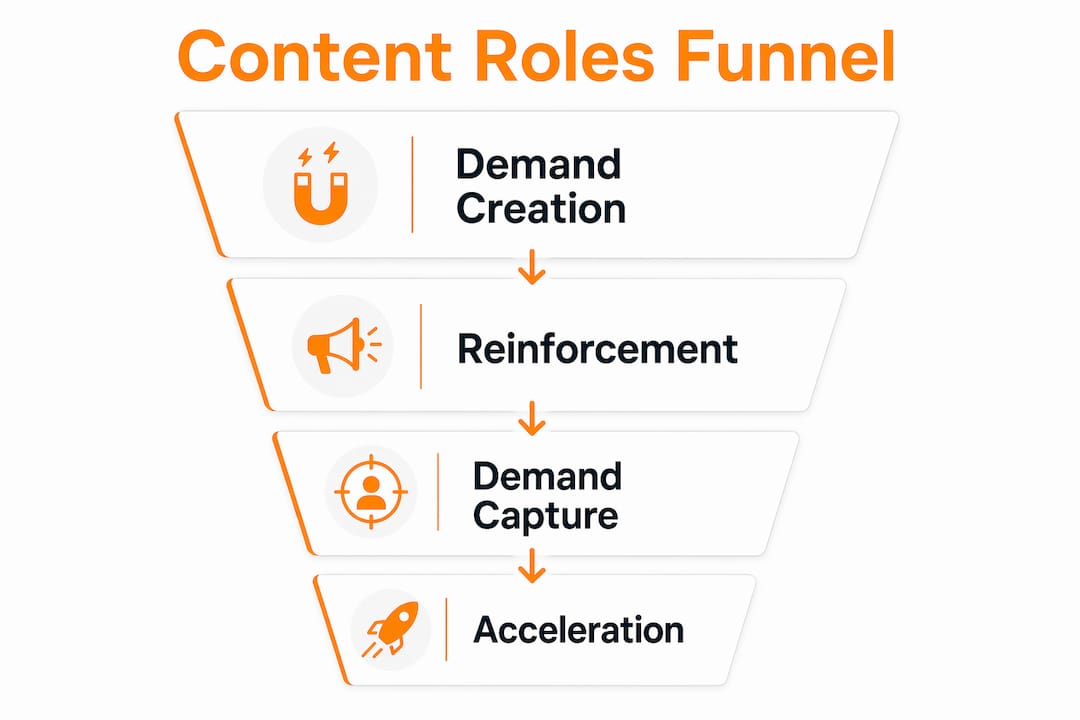
Paid campaigns fail when creators treat every ad as a single, all-purpose message. The fix is a four-role creative framework built around where your audience sits in their decision process. Demand Creation, Reinforcement, Demand Capture, and Acceleration each correspond to a distinct audience state and require a different message angle.
- Demand Creation targets cold audiences who do not yet recognize their problem. The message angle here is emotional or educational. A short-form video that names a frustration your audience experiences daily works far better than leading with your course price.
- Reinforcement serves audiences who have seen your content but have not converted. Social proof, testimonials, and behind-the-scenes content build the credibility layer that moves skeptical prospects forward.
- Demand Capture addresses warm audiences who are actively comparing options. Offer-forward messaging, clear pricing, and direct calls to action belong here. This is where UGC-style demos and results-focused case studies convert.
- Acceleration targets existing buyers or highly engaged non-buyers. Urgency-based content, limited bonuses, and community proof push fence-sitters to act.
The critical mistake most creators make is choosing a content format before defining the message angle and creative role. Practitioners must define messaging angle first, then select the format that best delivers it. A testimonial video placed in a cold-audience campaign confuses the viewer because they have no context for why that person’s result matters to them yet.
Pro Tip: Build a simple spreadsheet with four columns: funnel stage, audience temperature, message angle, and format. Fill it out before producing a single asset. This prevents the most common and expensive content mismatch in paid social.
Why organic content is non-negotiable for paid offer success
Paid ads introduce your offer. Organic content makes the audience trust it. These two functions are not interchangeable, and treating them as separate strategies is one of the most expensive mistakes a creator can make. Organic content reduces conversion friction by answering the trust and research questions that a 30-second ad cannot address on its own.
The importance of content in advertising extends well beyond the ad unit itself. When a prospect sees your paid ad and then searches your name, they will find your YouTube channel, your podcast, your LinkedIn posts, or your blog. That organic library either confirms the promise your ad made or contradicts it. In longer purchase cycles, which are common for courses, coaching programs, and digital memberships, organic content is the depth layer that sustains consideration between ad exposures.
- Authentic, unpolished organic content consistently outperforms highly produced paid ads on platforms like Meta and LinkedIn, because organic content provides authenticity that scripted ads cannot replicate.
- Higher education institutions and technology companies have both documented cases where organic content repurposed as paid creative outperformed purpose-built ad assets.
- Organic posts that answer common objections, such as “Is this worth the price?” or “Does this work for beginners?”, directly reduce the friction a prospect feels before clicking a paid offer.
- Content marketing for paid leads works best when organic posts are mapped to the same funnel stages as paid ads, creating a coherent message environment across every touchpoint.
Pro Tip: Repurpose your top-performing organic posts as paid creative before building new assets. The content that already earns organic engagement has proven resonance. Amplifying it with paid spend is the fastest way to test message-market fit without a production budget.
How storytelling and creative variety amplify paid offer results
Narrative-driven ads outperform feature-benefit messages by a significant margin. The World Federation of Advertisers found that storytelling lifts performance from 15% to 30% in top-performing campaigns, effectively doubling behavioral change effectiveness compared to ads that simply list product features. For creators selling courses or coaching programs, this means the transformation story of a real student will consistently outperform a bullet-point list of module topics.
Creative variety compounds this effect. Using at least two creative formats in a campaign increased sales lift by approximately 1.5x to 1.6x in Nielsen’s 2026 research. The reason is twofold. First, different formats reach different cognitive states in the same audience. A static image catches attention during passive scrolling while a video holds it. Second, creative variety allows ad algorithms to discover new audience segments that a single format would never surface.
| Creative approach | Effect on paid offer performance |
|---|---|
| Single format (video only) | Baseline performance; audience fatigue sets in quickly |
| Two formats (video + static) | Sales lift increases 1.5x to 1.6x per Nielsen data |
| Storytelling arc with characters | Behavioral change effectiveness doubles vs. feature ads |
| Humor or unexpected narrative | Improves memorability and reduces scroll-past rate |
| Regular creative refresh cycle | Prevents ROAS decline caused by algorithm concentration |
Ad fatigue from limited creative assets directly harms campaign return on ad spend. Algorithms concentrate spend on the few best-performing creatives quickly, which means the same audience sees the same ad repeatedly until performance collapses. The solution is a structured creative refresh cadence, not a larger budget. Creators who treat content as a testable system, rotating new angles every two to four weeks, sustain campaign performance far longer than those who produce one hero video and run it until it dies.
Full-funnel content coordination amplifies sales lift beyond what awareness-based efforts alone can achieve. Campaigns that reached more than 40% of their target audience while integrating upper- and lower-funnel tactics produced approximately 1.5x greater sales lift overall. This is the content strategy for paid campaigns that separates creators who scale from those who plateau.
Key takeaways
Content quality, funnel alignment, and creative variety are the three non-negotiable pillars of paid offer success for digital creators.
| Point | Details |
|---|---|
| Creative drives campaign outcomes | Creative quality accounts for 49–89% of performance variance, far outweighing targeting. |
| Assign roles before choosing formats | Define funnel stage and message angle first; format selection follows from that decision. |
| Organic content lowers conversion friction | Organic posts answer trust questions that paid ads cannot resolve in a single touchpoint. |
| Storytelling doubles behavioral change | Narrative-driven ads lift performance from 15% to 30% compared to feature-benefit messages. |
| Creative variety sustains ROAS | Using two or more formats increases sales lift by 1.5x and prevents algorithm-driven fatigue. |
What most creators get wrong about content and paid offers
The most persistent mistake I see creators make is treating their paid ad and their landing page as two separate creative decisions. They write a compelling ad hook, drive clicks, and then send traffic to a generic sales page that resets the persuasion process from zero. Matching landing page messaging to ad creative creates one continuous persuasion moment. The promise in your ad hook must be the first thing the visitor reads when they land. Any context switch between ad and page costs you conversions.
The second mistake is producing content in isolation rather than as a system. I have worked with creators who spent weeks building a single course launch video, ran it for three weeks, watched performance decline, and concluded that paid ads “don’t work for them.” What actually happened is that the algorithm exhausted the addressable audience for that one creative. Content refresh sequencing guided by paid data identifies where intent mismatches occur and tells you exactly which new angles to test next.
The third and most underrated lever is building content from real buyer language. A customer message map sourced from support calls and sales conversations produces ad copy that resonates at a level no amount of audience research can replicate. When your ad uses the exact phrase a buyer used to describe their problem, recognition is instant. That is how content drives paid offers at the highest level of efficiency.
The creators who build sustainable paid income are not the ones with the biggest production budgets or the most sophisticated targeting setups. They are the ones who treat content as a structured system, refresh it on a data-driven schedule, and align every asset from ad to landing page to follow-up email around a single coherent message. That is the content role in digital promotions that actually compounds over time.
— Sale
Turn your content into a monetization system with Revenueoperator
If you have built an audience but your paid offers still produce inconsistent revenue, the problem is almost always structural, not creative. Revenueoperator’s Monetization Architecture Method gives digital creators a proven framework for aligning content with every funnel stage, testing creative systematically, and converting free audiences into predictable monthly income.
Revenueoperator specializes in helping course developers and content entrepreneurs move from guesswork to a structured creator monetization system that scales. The platform supports creative testing workflows, funnel-stage content alignment, and audience insight analysis so you can stop producing content randomly and start building revenue architecture that works.
FAQ
What percentage of ad performance comes from creative quality?
Creative quality drives 49–89% of campaign performance according to research from Nielsen, Google, and Meta. Audience targeting contributes a much smaller share of outcomes than most advertisers assume.
How does organic content support paid offers?
Organic content answers trust and research questions that paid ads cannot resolve in a single exposure. It acts as a credibility layer that reduces conversion friction, particularly in longer purchase cycles like courses and coaching programs.
What are the four creative roles in a paid social funnel?
The four roles are Demand Creation, Reinforcement, Demand Capture, and Acceleration. Each corresponds to a distinct audience state and requires a different message angle and content format to perform effectively.
How often should creators refresh paid ad creative?
Creative refresh cycles of two to four weeks prevent the ad fatigue that causes ROAS decline. Algorithms concentrate spend on a small number of assets quickly, so rotating new angles sustains performance and allows the algorithm to discover new audience segments.
Does storytelling actually improve paid offer conversions?
Yes. The World Federation of Advertisers found that storytelling lifts campaign performance from 15% to 30% in top-performing ads, doubling behavioral change effectiveness compared to feature-benefit messaging.