What Does a Monetization Framework Mean for Your Business

A monetization framework is a structured planning system that defines exactly how a business or creator converts products, content, or data into consistent, repeatable revenue. It specifies pricing models, enforcement mechanisms, and the metrics used to measure and optimize long-term value. Unlike a vague revenue goal, a monetization framework gives you a concrete architecture: which models you use (subscriptions, freemium, in-app purchases), how you move users from free to paid, and which numbers tell you whether the system is working. For content creators, app developers, and business owners alike, understanding monetization frameworks is the difference between guessing at income and building it deliberately.
What does a monetization framework mean, and what are its core components?
A monetization framework strategically defines pricing models, enforcement mechanisms, and metrics to generate consistent revenue from products or data. The word “framework” is the key. It signals a repeatable system, not a one-time pricing decision. Successful frameworks combine methods like freemium, subscriptions, and in-app purchases, and they rely on customer lifetime value (LTV) as the north-star metric.
Three components appear in every well-designed framework. First, the revenue model: the mechanism by which money changes hands (subscription, one-time purchase, usage-based billing, advertising). Second, the conversion architecture: the path that moves a user from free access to paid commitment, including trial lengths, paywall placement, and upgrade triggers. Third, the measurement layer: the metrics that tell you whether the framework is healthy, including LTV, churn rate, average revenue per user (ARPU), and conversion rate.

Without all three components, you have a pricing page, not a framework. A pricing page tells users what things cost. A framework tells you why users pay, when they pay, and how to get more of them to pay more over time.
What are the main types of monetization frameworks across industries?
Monetization frameworks differ significantly by industry, but they share structural DNA. The table below maps the most common framework types to their primary revenue models and the sectors that use them most.
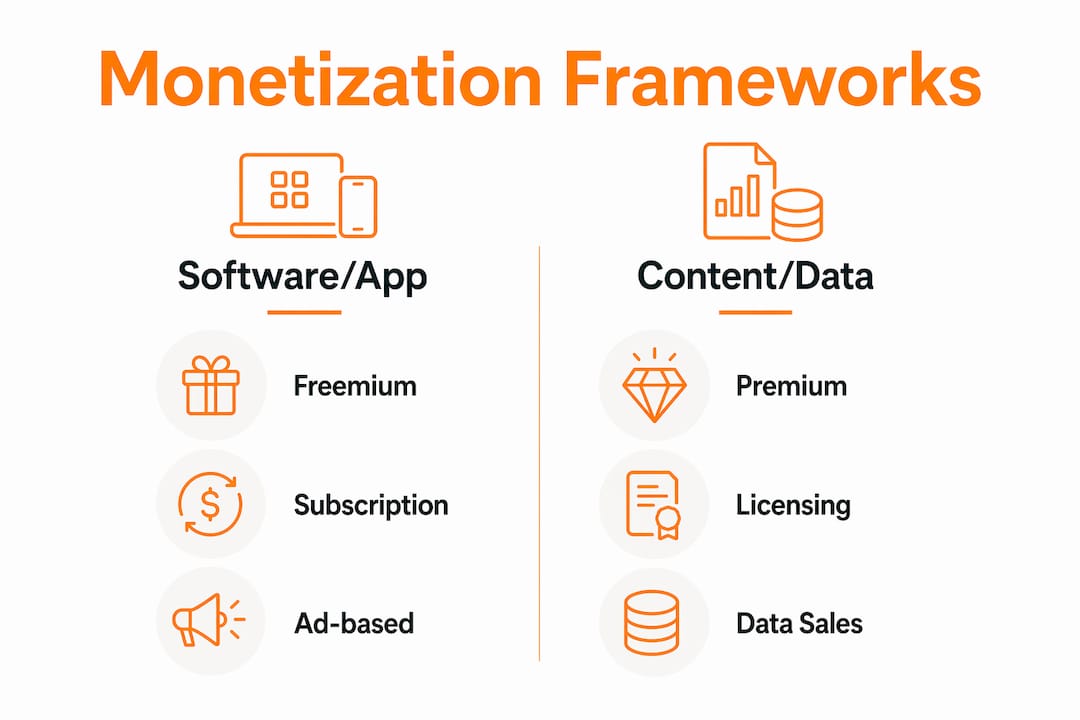
| Framework type | Primary revenue models | Common sectors |
|---|---|---|
| Software/app monetization | Freemium, subscription, in-app purchases | SaaS, mobile apps, gaming |
| Content creator stack | Ad revenue, memberships, digital products | Newsletters, YouTube, podcasts |
| Data monetization | Internal efficiency gains, external data sales | Finance, healthcare, retail |
| Service provider model | Retainers, project fees, premium tiers | Agencies, consultants, coaches |
Software and app frameworks are the most documented. Hybrid monetization models combining ads, subscriptions, in-app purchases, and other streams diversify income and improve resilience. Spotify uses this approach: free users generate ad revenue while paid subscribers generate subscription revenue. Different user segments fund the business through different mechanisms.
Content creator frameworks operate as multi-tier stacks. A typical stack looks like this:
- Free content (social media, YouTube) builds audience and trust
- A low-cost entry product (a $9 ebook or free email course) converts casual followers into buyers
- A core subscription ($29 to $99 per month) generates recurring revenue
- A premium offer (a $500 to $2,000 course or coaching program) captures high-intent buyers
Data monetization is structurally different. Data monetization entails internal efficiency improvements and external sale of data products, requiring documented lineage and compliance. A retailer might use its purchase data internally to reduce inventory waste, then license anonymized trend data to consumer goods brands. Both generate value from the same asset.
Why monetization is a product design decision, not an afterthought
Monetization is a product design decision integrated into features, user experience, and growth strategy, not just pricing. This is the insight most business owners miss. When you bolt monetization onto a product after launch, you discover that the product’s feature set, onboarding flow, and user expectations were all built around a free experience. Retrofitting a paywall into that structure is painful and often ineffective.
Apps that choose their monetization model early outperform those delaying decisions, often hitting higher revenue ceilings. The reason is structural. If you know from day one that revenue comes from a subscription, you build onboarding that demonstrates value fast. You design features that justify monthly payment. You set retention as a core product metric, not an afterthought.
The same principle applies to content businesses. A creator who decides upfront that their framework includes a paid community will build content that generates conversation and belonging, not just views. The monetization model shapes every creative decision downstream.
Pro Tip: Before you write a single piece of content or build a single feature, write a one-page monetization brief. State your primary revenue model, your secondary model, and the single metric that will tell you the framework is working. This document will save you months of repositioning later.
What metrics and operational processes optimize a monetization framework?
The metrics that matter most in any monetization framework are LTV, churn rate, conversion rate, and ARPU. Metrics like LTV better indicate product health than daily revenue spikes. A day with high sales but poor retention is a warning sign, not a win.
Operational optimization means treating your framework as a living system, not a fixed policy. Continuous operational testing such as A/B experiments on pricing and paywalls optimizes monetization performance over time. Static, set-it-and-forget approaches result in lost revenue opportunities and user frustration. Concretely, this means testing:
- Paywall placement (does showing the paywall after the third action or the fifth produce higher conversion?)
- Trial length (does a 7-day trial or a 14-day trial produce better paid conversion?)
- Price anchoring (does showing a $99 annual plan next to a $12 monthly plan increase annual plan uptake?)
- Upgrade messaging (does a feature-focused or outcome-focused upgrade prompt convert better?)
Monetization frameworks serve as living systems balancing value inflows and outflows to maintain economic sustainability. Yu-kai Chou’s economy design framework formalizes this as “sources and sinks.” Sources are the mechanisms that bring value into the system (purchases, subscriptions, ad impressions). Sinks are the mechanisms that consume value (refunds, churn, discounts). Frameworks that fail to balance sources and sinks risk collapse and revenue decline.
Pro Tip: Track LTV by acquisition channel, not just in aggregate. If users from organic search have a 3x higher LTV than users from paid ads, that insight should reshape your entire growth budget. Use a tool like customer lifetime value analysis to segment and act on this data.
How to build a diversified monetization stack for content creators and businesses
A diversified monetization stack is a set of complementary revenue streams that serve different user segments at different price points. Best practice is to keep no single revenue source above 50% of total revenue. When one stream declines, the others absorb the impact. This is the structural difference between a creator who survives an algorithm change and one who loses 80% of income overnight.
Building a stack is a phased process. Here are the steps:
- Identify your audience’s value ladder. What does your audience need at the awareness stage, the consideration stage, and the commitment stage? Map a product or offer to each stage.
- Launch your lowest-friction product first. A free email course, a $9 ebook, or a free community membership converts the most people and builds your buyer list.
- Add a recurring revenue layer. A monthly membership, subscription newsletter, or software tool creates predictable income. This is your framework’s backbone.
- Introduce a premium offer. A high-ticket course, coaching program, or done-for-you service captures your highest-value buyers. This tier often generates 40 to 60 percent of total revenue from a small percentage of customers.
- Test a secondary passive stream. Affiliate partnerships, licensing, or sponsorships add income without proportional time investment.
Content creators develop multi-tier stacks integrating low-friction products, core subscriptions, and premium services to diversify income. It typically takes 12 to 24 months of consistent effort to reach $1,000 monthly affiliate or content revenue. That timeline is not a discouragement. It is a planning input. If you know the ramp takes 18 months, you build a cash flow plan that accounts for it rather than abandoning the framework at month six.
Common pitfalls in monetization framework implementation
The most common failure in monetization is single-stream dependence. A creator who earns 90% of revenue from one YouTube ad revenue stream, or a SaaS company that earns 90% of revenue from one enterprise client, has a revenue number but not a framework. One platform policy change or one client departure ends the business.
The second major pitfall is aggressive short-term monetization that damages user trust. Balancing short-term revenue with long-term trust supports sustainable monetization, and aggressive tactics can harm retention. Mobile games that front-load paywalls before delivering value see high early revenue and catastrophic churn. The short-term spike looks good in a weekly report. The long-term damage shows up in LTV data six months later.
“Approaching monetization as part of product architecture leads to higher conversion and user satisfaction.” — Branch.io
The third pitfall is reactive monetization: adding revenue streams in response to income drops rather than by design. A creator who launches a course because ad revenue fell is reacting. A creator who planned a course as the third tier of a deliberate stack is executing. The difference is not the product. It is the system behind the product.
Advanced frameworks address these risks by building in regular review cycles. Every quarter, audit your revenue mix, your LTV by segment, and your churn drivers. Adjust pricing, offers, and conversion architecture based on data, not intuition.
Key takeaways
A monetization framework is the structured system that converts audience engagement into predictable, diversified revenue. Without it, income is reactive and fragile.
| Point | Details |
|---|---|
| Define all three components | Every framework needs a revenue model, a conversion architecture, and a measurement layer. |
| Embed monetization early | Building pricing and conversion logic into product design from day one raises revenue ceilings. |
| Diversify revenue streams | No single stream should exceed 50% of total revenue to protect against platform or market shifts. |
| Test and iterate continuously | A/B test paywall placement, trial lengths, and pricing regularly to prevent stagnation. |
| Track LTV over daily revenue | Lifetime value by segment reveals which channels and products actually build sustainable income. |
Why most monetization advice misses the point
I have reviewed hundreds of monetization plans from creators and business owners, and the pattern is consistent. Most people treat monetization as a revenue problem when it is actually a systems problem. They ask “how do I make more money?” when the real question is “how do I build a system that generates money predictably?”
The frameworks that work are not the most complex ones. They are the ones built with the clearest logic: a defined audience, a value ladder that matches that audience’s progression, and metrics that tell you whether the system is healthy. I have seen creators with 5,000 email subscribers outperform creators with 500,000 social followers because the smaller creator had a deliberate stack and the larger one had only ad revenue.
The trust dimension is also underweighted in most monetization discussions. Users who feel that a product is designed around their success will pay more, stay longer, and refer others. Users who feel that a product is designed to extract money will churn and warn others. LTV is not just a financial metric. It is a proxy for how well your framework respects the people inside it.
If I could give one piece of advice to anyone building a monetization framework, it would be this: decide what your framework looks like before you have an audience, not after. The decisions you make about pricing, conversion, and revenue mix will shape every product and content decision that follows.
— Sale
How Revenueoperator helps you build a monetization framework that works
Revenueoperator is built specifically for creators and business owners who are done with inconsistent income and ready to build a real revenue system. The Monetization Architecture Method gives you a structured path from free audience to paid offers, with a clear conversion architecture and the metrics to know whether it is working. You do not need to guess at pricing, test offers randomly, or rebuild your strategy every time one stream underperforms. Revenueoperator provides the framework, the tools, and the proven sequence. Explore how to build your monetization system and move from unpredictable earnings to a reliable monthly income.
FAQ
What does a monetization framework mean?
A monetization framework is a structured system that defines how a business or creator generates consistent revenue through pricing models, conversion architecture, and performance metrics. It is the operational plan behind how money is made, not just a list of prices.
What is the difference between a monetization model and a monetization framework?
A monetization model is a single revenue mechanism, such as a subscription or freemium plan. A monetization framework is the broader system that combines one or more models with conversion logic, user segmentation, and measurement processes.
How do you create a monetization framework from scratch?
Start by identifying your audience’s value ladder, then map a product or offer to each stage from free to premium. Add a recurring revenue layer as your backbone, introduce a high-ticket offer for committed buyers, and set LTV and churn as your primary health metrics.
Why is diversification important in a monetization framework?
Keeping no single revenue source above 50% of total income protects your business when one stream declines. A diversified monetization stack targeting different user segments increases resilience and reduces the risk of a single platform or market shift ending your revenue.
What metrics should I track to optimize my monetization framework?
Track customer lifetime value (LTV), churn rate, conversion rate, and average revenue per user (ARPU). LTV by acquisition channel is especially revealing because it shows which growth investments actually build sustainable income rather than short-term spikes.