What Is an Educator Monetization Model? 2026 Guide

An educator monetization model is the structured system educators and course creators use to convert learner engagement into consistent income through packaging, pricing, and strategically timed conversion triggers. The term “educator monetization model” is the widely used phrase in the creator economy, though the underlying concept maps directly to what business strategists call a revenue architecture. Understanding this architecture is what separates educators who earn sporadically from those who build predictable monthly income. Platforms like Teachable, Patreon, and Kajabi all operate on distinct versions of this model, and the monetization layer defines the when, what, and how of charging learners. Getting that layer right is the single most consequential decision you will make as an online educator.
What is an educator monetization model and why does it matter?
An educator monetization model defines how revenue is generated through packaging, pricing, and conversion triggers aligned to learner engagement. It is not simply “charging for a course.” It is the full logic that determines what you offer for free, what sits behind a paywall, how you price each tier, and at what moment in the learner journey you ask for payment.
Most educators start by giving away content on YouTube, a newsletter, or a free mini-course. The mistake is treating that generosity as a strategy rather than as the top of a funnel. The monetization model is the architecture that turns that free audience into revenue without guessing or running endless promotions.
Three core elements make up any educator revenue model. First, packaging defines how knowledge is bundled, whether as a standalone course, a live cohort, a membership, or a consulting engagement. Second, pricing architecture determines the price points, tiers, and discount logic. Third, conversion triggers are the moments when a learner is most likely to upgrade or purchase, usually tied to a specific milestone or progress point inside the learning experience.

Named platforms illustrate this clearly. Teachable defaults to one-time course purchases. Patreon is built around recurring membership tiers. Kajabi supports all three elements in one system. Choosing the right platform matters far less than choosing the right model first.
What are the common educator monetization model types?
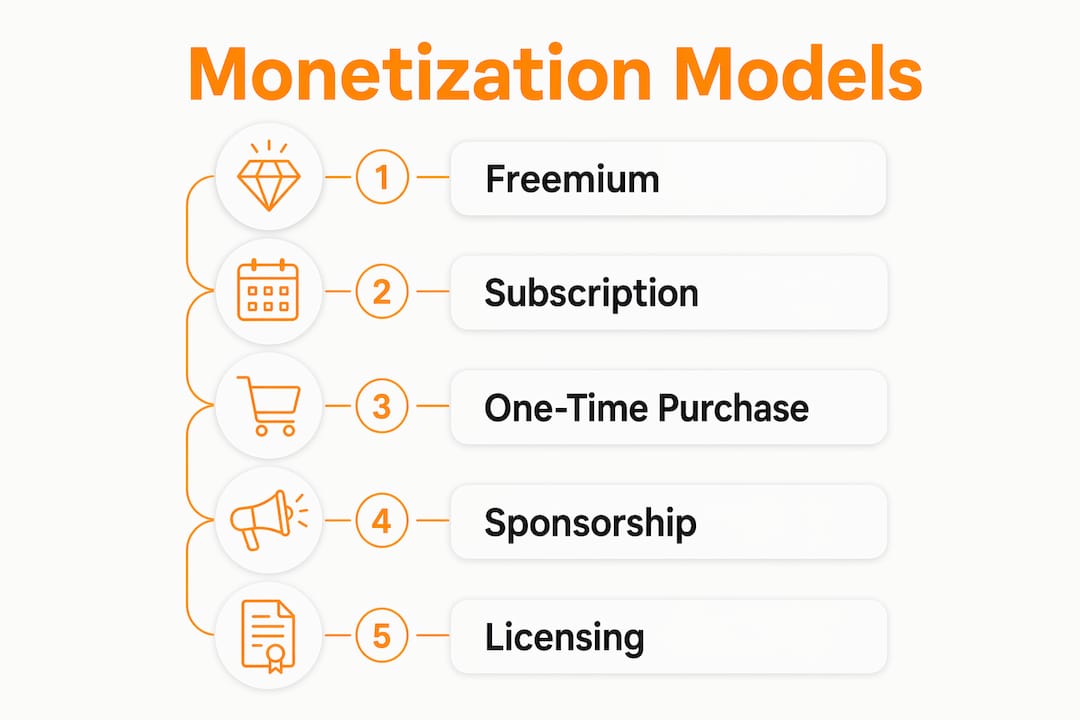
Common monetization models in education include freemium, subscriptions, one-time purchases, sponsorship, licensing, and B2B district licensing. Each model serves a different audience size, content type, and business goal.
| Model | Typical price point | Best for | Scalability |
|---|---|---|---|
| Freemium | Free core, $9–$29/mo premium | Apps, micro-courses | High |
| Subscription/Membership | $19–$99/month | Ongoing skill-building | Medium-High |
| One-time purchase | $50–$2,000 per course | Defined outcomes | High |
| Coaching/Consulting | $100–$500/hr | Personalized transformation | Low |
| Sponsorship | Variable | Large audience creators | Medium |
| B2B/District licensing | $3–$8/student/month or $10,000+ per district | EdTech tools, school adoption | Very High |
Freemium is the most common entry point for new educators. You offer the core experience for free and gate advanced features, certificates, or live access behind a paid tier. The model builds audience fast but requires a clear upgrade path to convert free users into paying ones.
Subscription and membership models generate recurring revenue, which is the most predictable form of educator income. A membership priced at $49 per month with 200 active members produces $9,800 monthly before any course sales. The trade-off is that members expect consistent new content, live sessions, or community value to justify the recurring charge.
One-time course purchases remain the most popular format for independent educators. Platforms like Teachable and Thinkific are built around this model. A well-positioned course priced between $297 and $997 can generate significant revenue from a modest email list without requiring ongoing content production after launch.
Pro Tip: Most successful courses use a hybrid monetization funnel that combines a free or low-cost entry point with a mid-tier course and a high-ticket coaching offer. This structure supports acquisition, retention, and premium upsells from the same audience.
Sponsorship and licensing models work best once you have an established audience or a tool with institutional demand. B2B licensing, in particular, offers the highest revenue ceiling. EdTech tools like Filmit for Schools structure school subscription tiers specifically to capture institutional budgets, which are larger and more stable than individual consumer spending.
How does behavioral monetization improve revenue in education products?
Behavioral monetization is the practice of timing payment requests to moments when a learner is most engaged and least willing to stop. Monetization moments tied to costly-to-interrupt progress inside lessons outperform early-paywall approaches by a significant margin. This is not a trick. It is applied behavioral economics.
Consider the difference between two approaches. In the first, a learner lands on your course page and immediately hits a paywall before consuming any content. In the second, the learner completes three free lessons, builds a partial skill, and then encounters a paywall just before the lesson that would complete their first meaningful project. The second scenario creates what psychologists call the sunk cost effect. Stopping now means losing the progress already made.
“Conversion paths within education products should map payment triggers to key learner milestones and progression points to maximize lifetime value.” — Education App Monetization models
Progress-based paywalls are one execution of this principle. Another is triggered upgrade prompts inside a free community or membership when a member reaches a specific engagement threshold, such as completing five posts or attending two live calls. These triggers signal that the learner is invested and therefore more likely to convert to a paid tier.
Early or arbitrary monetization, such as placing a paywall on lesson one or sending a sales email on day two of a free trial, consistently underperforms because it asks for commitment before value has been demonstrated. The learner has no sunk cost and no emotional reason to pay.
Pro Tip: Design your free content to end at a natural cliffhanger. The last free lesson should deliver a genuine win while making the next step, which sits behind the paywall, feel like the obvious continuation. This is the single most effective conversion trigger available to course creators.
What practical multi-layer monetization strategies can educators implement?
A diversified three-layer monetization model combining memberships, signature courses, and high-touch offers stabilizes income and protects against the volatility of any single revenue source. Here is how each layer functions and how they work together.
Layer 1: Owned recurring revenue (membership or subscription)
This is your income floor. A membership priced at $29 to $79 per month provides predictable cash flow regardless of whether you launch anything new. It also keeps your audience warm and engaged between launches. Build this layer on an owned platform, not a rented one. Email lists and private communities on platforms like Circle or Mighty Networks give you control that YouTube or Instagram cannot.
Layer 2: Core evergreen course (one-time purchase)
This is your primary revenue driver. A signature course priced between $297 and $1,497 addresses a specific, high-stakes problem your audience faces. Evergreen courses run on automated email sequences and can generate revenue without live launches once the funnel is set up. This layer scales without adding to your workload.
Layer 3: High-touch offers (workshops, coaching, consulting)
This is your income ceiling. Live workshops priced at $197 to $497 and one-on-one coaching programs priced at $500 to $2,000 or more per engagement generate premium revenue from a small number of buyers. The time investment is high, but so is the perceived value and the margin.
A practical 90-day execution plan for educators starting from scratch looks like this:
- Weeks 1 to 4: Validate your core topic by running a paid live workshop at $97 to $197. This tests demand before you build anything.
- Weeks 5 to 8: Convert the workshop recording and materials into a self-paced course. Price it at $297 or higher.
- Weeks 9 to 12: Launch a membership at $29 to $49 per month for learners who want ongoing access, community, and live Q&A sessions.
This sequence builds each layer on proven demand rather than assumptions. You earn revenue in week one, not week twelve.
- Prioritize building your email list over growing social media followers. Email converts at three to five times the rate of social media posts for course sales.
- Use platforms like ConvertKit or Kit for email automation and Loom for async video content inside memberships to reduce live facilitation time.
- Set a minimum viable membership size of 50 paying members before investing heavily in content production.
How do different educator product formats compare in revenue potential?
Typical pricing ranges for educational offerings vary widely: subscriptions run $19 to $99 per month, courses range from $50 to $2,000, and coaching commands $100 to $500 per hour or $500 to $2,000 or more per program. Each format carries a different operational profile that affects how you spend your time and how your income scales.
| Format | Price range | Scalability | Time intensity | Best launch sequence |
|---|---|---|---|---|
| Self-paced course | $97–$2,000 | High | Low (after creation) | First or second |
| Membership | $19–$99/month | Medium | Medium (ongoing) | After course audience exists |
| Group coaching | $500–$3,000/program | Medium | High | Second or third |
| 1:1 Coaching | $100–$500/hr | Low | Very high | Anytime for premium buyers |
| Live workshop | $97–$497 | Medium | High (per event) | First (for validation) |
Courses scale the most efficiently because the content is created once and sold repeatedly. A course priced at $497 sold to 100 students generates $49,700 from a single asset. The challenge is that courses require marketing investment to maintain consistent sales after the initial launch excitement fades.
Memberships require continuous content delivery, and building them after a proven course audience dramatically improves retention. Launching a membership to a cold audience is one of the most common and costly mistakes educators make. Members join for community and ongoing value, and they cancel when either disappears.
Coaching commands the highest hourly rate but does not scale without systems. Educators who rely solely on one-on-one coaching hit an income ceiling defined by available hours. The solution is to use coaching as a premium tier within a larger funnel, not as the primary revenue model.
Pro Tip: Before launching a membership, run your course or workshop at least twice. The feedback from those buyers tells you exactly what ongoing content your members will pay for month after month. Skipping this step is the primary reason memberships fail within six months.
Filmit’s subscription pricing structure for education tools illustrates how institutional buyers think about value differently than individual learners. Schools pay for compliance, scalability, and curriculum alignment. Individual educators pay for personal transformation and career outcomes. Knowing which buyer you are serving shapes every pricing decision you make.
Key takeaways
A structured educator monetization model built on multiple revenue layers is the most reliable path from inconsistent income to predictable monthly earnings.
| Point | Details |
|---|---|
| Define your revenue architecture first | Packaging, pricing, and conversion triggers must be designed before choosing a platform. |
| Match the model to your audience size | Freemium and courses suit smaller audiences; memberships and B2B licensing scale with larger ones. |
| Time conversion triggers to learner progress | Paywalls placed at milestone moments convert significantly better than early or arbitrary gates. |
| Build three revenue layers | Memberships provide the income floor, courses drive core revenue, and coaching creates the income ceiling. |
| Launch memberships after courses | Proven course audiences retain membership subscriptions at far higher rates than cold audiences. |
Why most educators are building their monetization model backwards
The conventional advice tells educators to start with a free audience, grow it for months or years, and then figure out monetization later. That advice costs educators real money and real time. What I have seen consistently is that educators who define their revenue architecture before they create content build income faster and with less content overall.
The risk of ad-based or platform-dependent income is not theoretical. It is the lived experience of thousands of educators who built YouTube channels or Facebook groups only to watch algorithm changes cut their reach and their income simultaneously. Replacing ad income with memberships, signature courses, and workshops is not just a strategy. It is a form of financial self-defense.
Micro-credentials and cohort-based courses are the two formats I watch most closely heading into the next few years. Learners increasingly want proof of skill, not just access to content. Educators who attach verifiable outcomes to their programs will command higher prices and face less price competition from generic course platforms.
The educators who will thrive are those who treat their monetization model as a living system, not a one-time decision. Start with one layer, prove it works, then add the next. Iteration beats perfection every time.
— Sale
How Revenueoperator helps educators build predictable income
Revenueoperator was built specifically for the problem this article describes: educators and course creators who have an audience but lack the structured revenue system to convert that audience into consistent income.

The Monetization Architecture Method inside Revenueoperator maps your packaging, pricing tiers, and conversion triggers into a single coherent system. Instead of guessing which offer to launch next or why your course sales stall after the first week, you work from a proven framework that sequences your revenue layers in the right order. Educators using this method have moved from unpredictable monthly income to structured, recurring revenue without adding more content or working more hours. If you are ready to stop guessing and start building, start your monetization architecture with Revenueoperator today.
FAQ
What is an educator monetization model?
An educator monetization model is the revenue system that defines how an educator packages, prices, and triggers purchases from their learner audience. It includes the full logic of what is free, what is paid, and when payment is requested relative to learner engagement.
What are the most common educator monetization model types?
The most common types are freemium, subscription or membership, one-time course purchase, coaching, sponsorship, and B2B licensing. Most successful educators combine two or three of these into a layered revenue system.
How do I choose between a course and a membership?
Launch a course first to build a proven audience, then add a membership for learners who want ongoing access and community. Memberships launched without an existing course audience suffer from high churn because there is no established trust or content baseline.
What price should I charge for my online course?
Course pricing typically ranges from $50 to $2,000 depending on the depth of the outcome, the audience’s ability to pay, and the level of support included. A course solving a high-stakes professional problem justifies prices above $500, while introductory skill courses typically price between $97 and $297.
Why is behavioral monetization more effective than early paywalls?
Behavioral monetization places payment requests at moments when learners have already invested time and progress, creating a psychological cost to stopping. Early paywalls ask for commitment before any value is demonstrated, which consistently produces lower conversion rates.